We know what you're looking for.
And we have the right neoprene.

What is neoprene?

What is neoprene?

Neoprene, the commercial name for polychloroprene, is a family of synthetic rubbers obtained through the polymerization of chloroprene. Developed in the 1930s as the first large-scale alternative to natural rubber, it is now one of the most versatile technical materials used in industrial and sports applications.

From a structural point of view, neoprene is a closed-cell rubber: inside it contains microcells filled with gas, evenly distributed. This particular structure makes it lightweight, elastic, flexible, and capable of providing excellent insulating performance.

Density can vary depending on the final application: there are softer and more elastic formulations, ideal for technical sportswear, and high-density (HD) versions used in applications requiring greater resistance and stability.

 

Properties of Neoprene

Thermal insulation

Neoprene is an excellent insulator against both cold and heat. The closed cells trap air, reducing heat dispersion and maintaining a stable body temperature. This makes it particularly suitable for wetsuits and technical garments for water sports.

Waterproofing and water repellency

Neoprene is resistant to water and vapor. Closed-cell versions offer high waterproofing and prevent water from easily penetrating the material. It can also be treated with water-repellent finishes to further enhance its ability to repel liquids.

Chemical and weather resistance

It is highly resistant to UV rays, ozone, rain, and temperature fluctuations. It also shows good resistance to oils, fuels, and many chemical agents, making it ideal for industrial applications.

Durability over time

Neoprene ages well: it maintains elasticity and performance even after prolonged use. It resists tearing, abrasion, and compression, preserving its shape and functionality over time.

What is neoprene?

From design to industry:
all its applications

One of the reasons neoprene is so widespread is its exceptional workability. It can be cut into complex shapes, bonded to other materials, sewn, perforated, or even thermoformed to create three-dimensional structures.

It is compatible with both industrial and artisanal techniques, from mass production to custom prototyping.

Its mechanical properties make it an ideal ally for those seeking a technical solution without compromising design freedom.

Versatility and fields of use

Although commonly associated with wetsuits, neoprene is used in many sectors.

The ability to adjust density, thickness, and material combinations makes neoprene extremely adaptable to different needs.

In sports, it is used for diving suits, surfing, freediving, as well as knee braces, wrist supports, and orthopedic supports.

In industry, it is used for gaskets, hoses, belts, protective coatings, and construction membranes.

In consumer products, it is found in laptop sleeves, mouse pads, and protective items.

In fashion, it is used in clothing such as skirts and vests, as well as bags and accessories like bandanas.

FAQ

Key information
about Neoprene

Closed-cell neoprene is highly waterproof and water-resistant. However, complete waterproofing also depends on processing (stitching, bonding, heat sealing) and the type of finished product. In our catalog, water-repellent materials are available in various colors, thicknesses, and types (single-lined and double-lined).

Yes, neoprene can be sewn, but only on the lined side and it requires suitable needles and threads. Flat, taped, or glued seams are often used to maintain elasticity and waterproofing. Proper tension adjustment is essential to avoid material deformation.

Neoprene is available in different options to meet every technical and production need.

It can vary by:

  • Thickness: from 1.5 mm to 9.5 mm
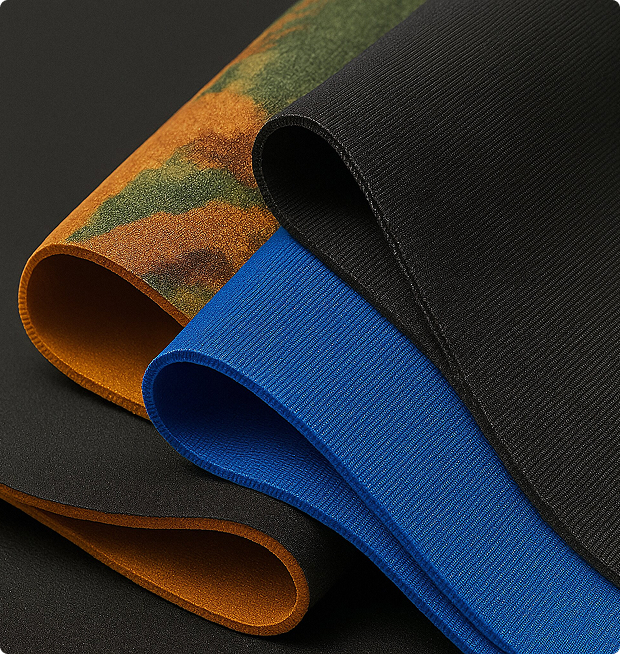
  • Color: solid colors, camouflage variants, and a wide selection of shades
  • Density: Soft, Medium, and High versions
  • Material: double-lined (fabric on both sides), single-lined (fabric on one side), or unlined

Our catalog offers one of the most complete selections on the market, with unique availability in Italy and recognition internationally.

Yes, it is generally suitable for direct skin contact and widely used in technical and sportswear. In rare cases, some individuals may experience allergic reactions, which is why hypoallergenic materials exist. In our catalog, we offer the full Yamamoto 45 line and a selection of Sheico products, chosen to provide high standards of quality, performance, and comfort in contact with the skin.

Neoprene maintains good mechanical properties at both low and high temperatures and resists aging, weather conditions, and ozone well. Performance may vary depending on the specific formulation.

We have always sought truly ecological solutions for neoprene disposal in our production process, but currently there is no fully sustainable solution. Therefore, we have chosen to give it a second life by selling neoprene scraps by weight. They are available in standard packages of 8 kg and 15 kg at a favorable price, or in custom formats upon request. For availability and further details, please contact us directly.

Yes, but pricing, quantities, and supply times must be evaluated, as orders must be included in seasonal supply batches to reduce shipping costs and obtain better prices. We recommend contacting us to assess your request.

Yes, we can send sample cuts to evaluate quality and color; you only pay for shipping.

Yes, but the required material must be reserved in advance.

Lined neoprene is fairly resistant to sunlight but may fade over time, while smooth neoprene is less resistant to UV rays.

Materials from leading manufacturers

We stock neoprene from only the best international manufacturers.

Do you need help choosing
the material?

Please contact us if you have any questions or specific requirements.
We’ll help you find the right solution for you.

Via Cattaneo 5, Cattolica (RN) 47841

+39 0541 963831

info@ilneoprene.it